

You tell yourself it is harmless because the amount is small.
You think that because it is only ten dollars, it doesn’t count as a relapse. You might even convince yourself that you are testing your control, proving that you can handle “just a little bit.”
But the amount of money you put down has nothing to do with the mechanism of addiction.
When you place that small bet, you aren’t just risking ten dollars. You are reactivating a dormant neural pathway that you have worked incredibly hard to close off. You are sending a signal to your brain that the door is still open.
And once that door is cracked open, even an inch, the brain chemistry takes over.
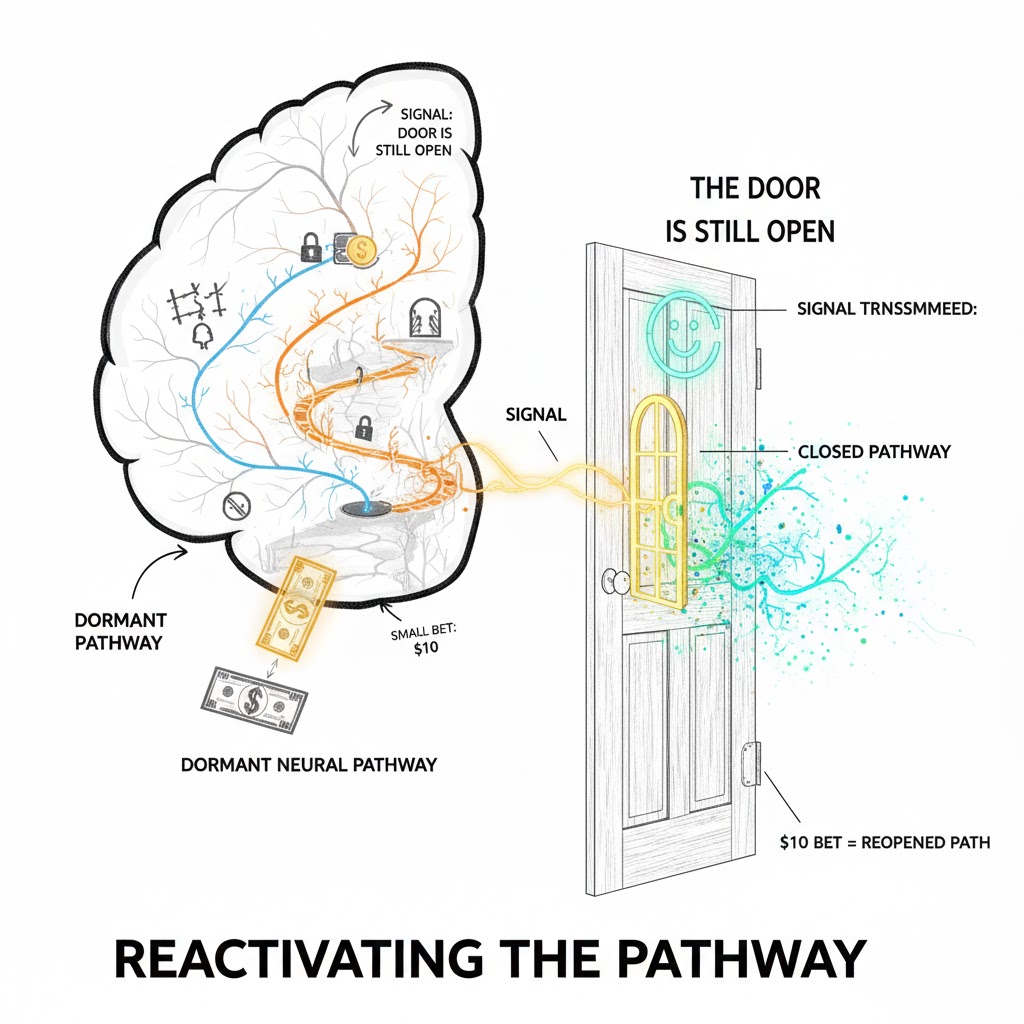
So, we need to stop looking at the dollar amount. We need to look at what is actually happening inside your mind you make that transaction. Because if we don’t understand the trap of the “small bet,” we can’t build a defense against it.
The Brain Doesn’t Know the Difference Between a Penny and a Fortune
I’ll be honest with you.
Most people think gambling addiction is about the desire for money. They assume that if the potential reward is low, the addiction won’t trigger.
But that is not how our biology works.
The brain releases dopamine—the chemical messenger of pleasure and anticipation—based on the uncertainty of the outcome, not just the size of the prize. This involves a complex neurological process where the reward prediction error triggers a massive dopamine spike.
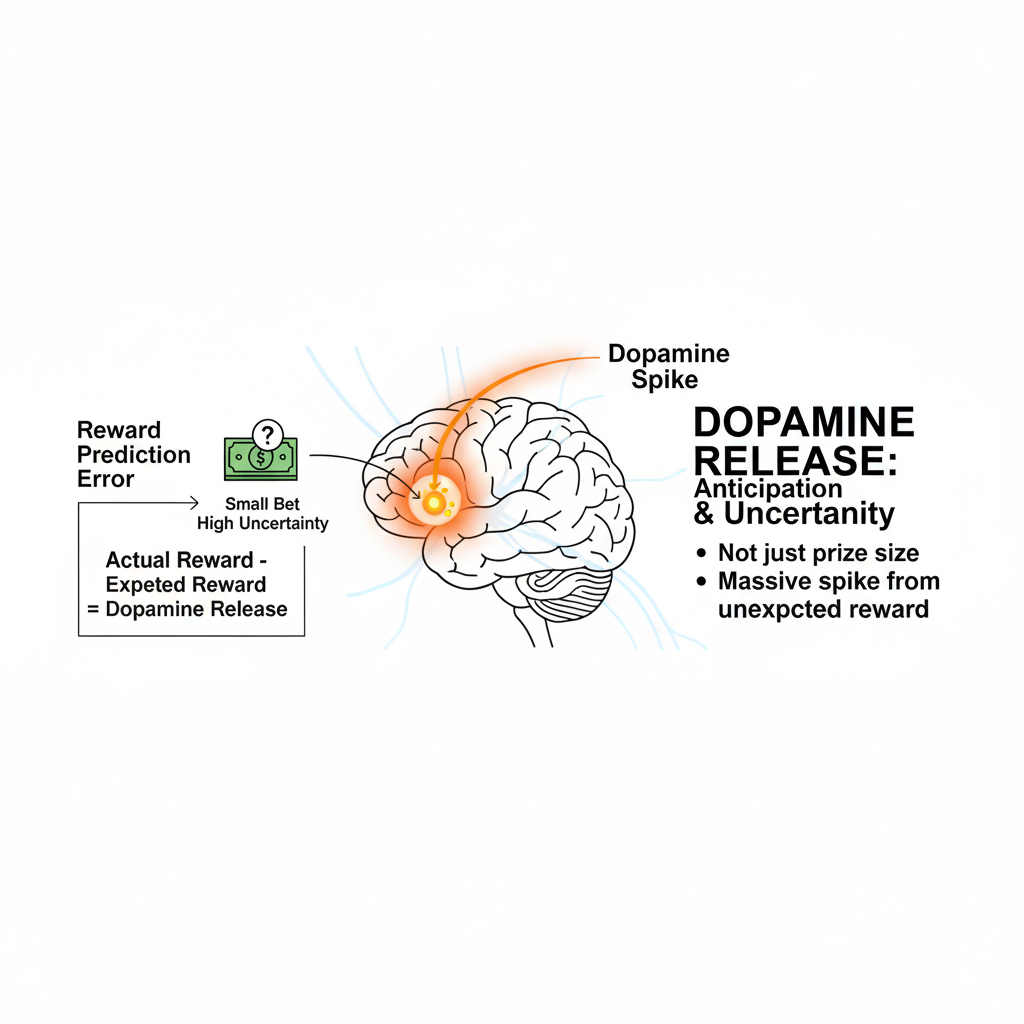
When you engage in the action of betting, your brain enters a state of “reward prediction error.” It is trying to predict what will happen next. That anticipation is what floods your system with dopamine.
So, whether you are putting down a single dollar or a thousand dollars, the chemical reaction is shockingly similar.
The neurological spark
Think of it like lighting a fuse.
It doesn’t matter if you use a small match or a large flamethrower to light it. Once the fuse is lit, the explosion at the end is inevitable.
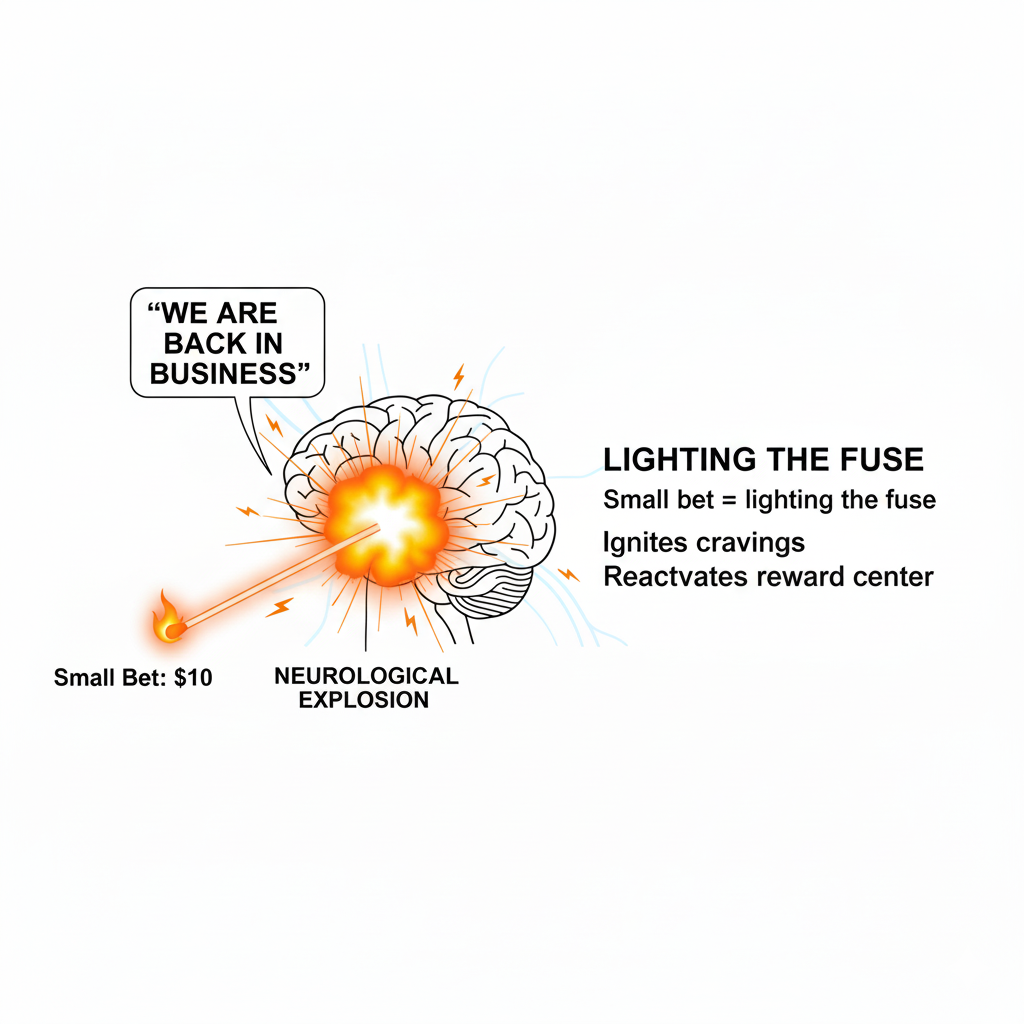
When you bet $10, you are lighting the fuse.
You are stimulating the reward center of your brain. For a brain that has been sensitized to gambling, this stimulation is not casual. It is a direct hit. It wakes up the cravings that may have been sleeping for days, weeks, or months.
So, by validating a small bet, you are effectively telling your brain: “We are back in business.”
The “Just a Little Bit” Trap is the Hardest to Escape
There is a reason why most relapses start small.
If you felt the urge to bet your entire savings account immediately, your survival instincts would likely kick in. You would feel fear. You would recognize the danger and pull back.
But ten dollars? That feels safe.
It feels manageable. It flies under the radar of your survival instincts.
This is what makes it so dangerous. It bypasses your internal alarm system. You lower your guard because the immediate financial threat is low.
The illusion of control
You might tell yourself: “I will stop after this one.”
But gambling addiction is defined by an inability to stop. By engaging in the act, you are stepping into the ring with an opponent that has defeated you before.
The “just a little bit” mentality is a rationalization. It is your addiction trying to negotiate with your recovery.
And here is the hard truth: You cannot negotiate with brain chemistry.
Once you start, the prefrontal cortex—the part of your brain responsible for logic and decision-making—begins to shut down. The emotional brain takes the wheel. At that point, your logical plan to “stop at $10” becomes irrelevant.
Small Bets Keep the Neural Pathways Paved
Imagine your addiction is a physical path through a dense forest.
When you were gambling heavily, that path was a superhighway. It was wide, paved, and easy to travel.
When you stop gambling and enter recovery, that path begins to overgrown. Grass grows through the cracks. Bushes start to block the way. It becomes harder and harder for your brain to go down that road.
This is how recovery works physically in the brain. We weaken the old connections and build new ones.
But every time you place a small bet, you are driving a car down that old highway.
Clearing the weeds
You are crushing the new growth. You are reminding your brain exactly where that road is and how easy it is to travel.
Even a $10 bet keeps the pathway clear.
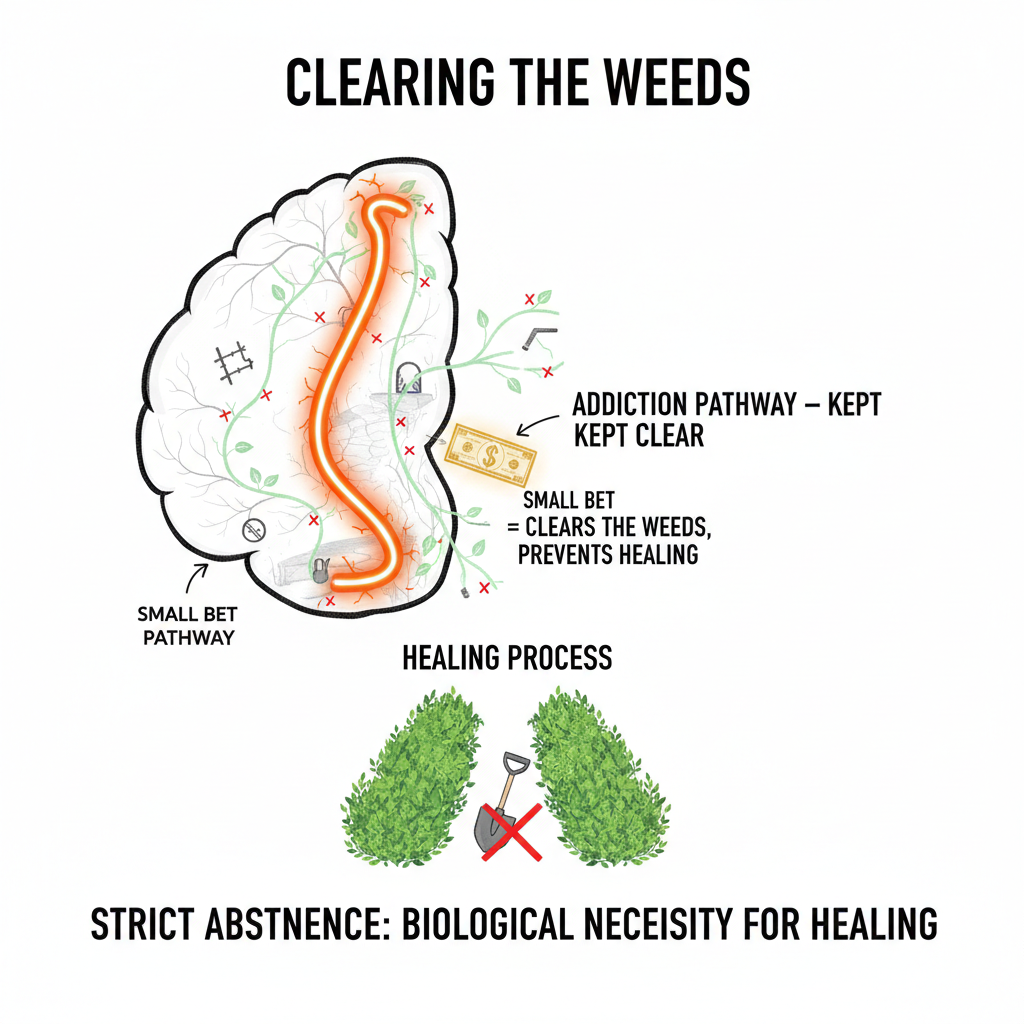
It prevents the brain from resetting. It keeps the addiction “fresh” in your mind.
This is why people who try to “cut down” rather than quit often struggle so much. They are constantly tearing open the healing wounds. They are never allowing the brain to fully restructure itself around healthy activities.
So, strict abstinence isn’t just a rule. It is a biological necessity for the brain to heal.
Recovery Requires Complete Safety, Not Risk Management
I have seen many people try to manage their addiction like a budget.
They set limits. They use “play money.” They try to be responsible.
But for someone with a history of compulsive behavior, this approach is fundamentally flawed.
The goal of recovery is not to become a “better” gambler. The goal is to remove the source of the pain entirely.
When you allow small bets, you are living in a constant state of risk management. You are using willpower every single minute to keep that small bet from turning into a big one.
The exhaustion of willpower
Willpower is a finite resource. You only have so much of it each day.
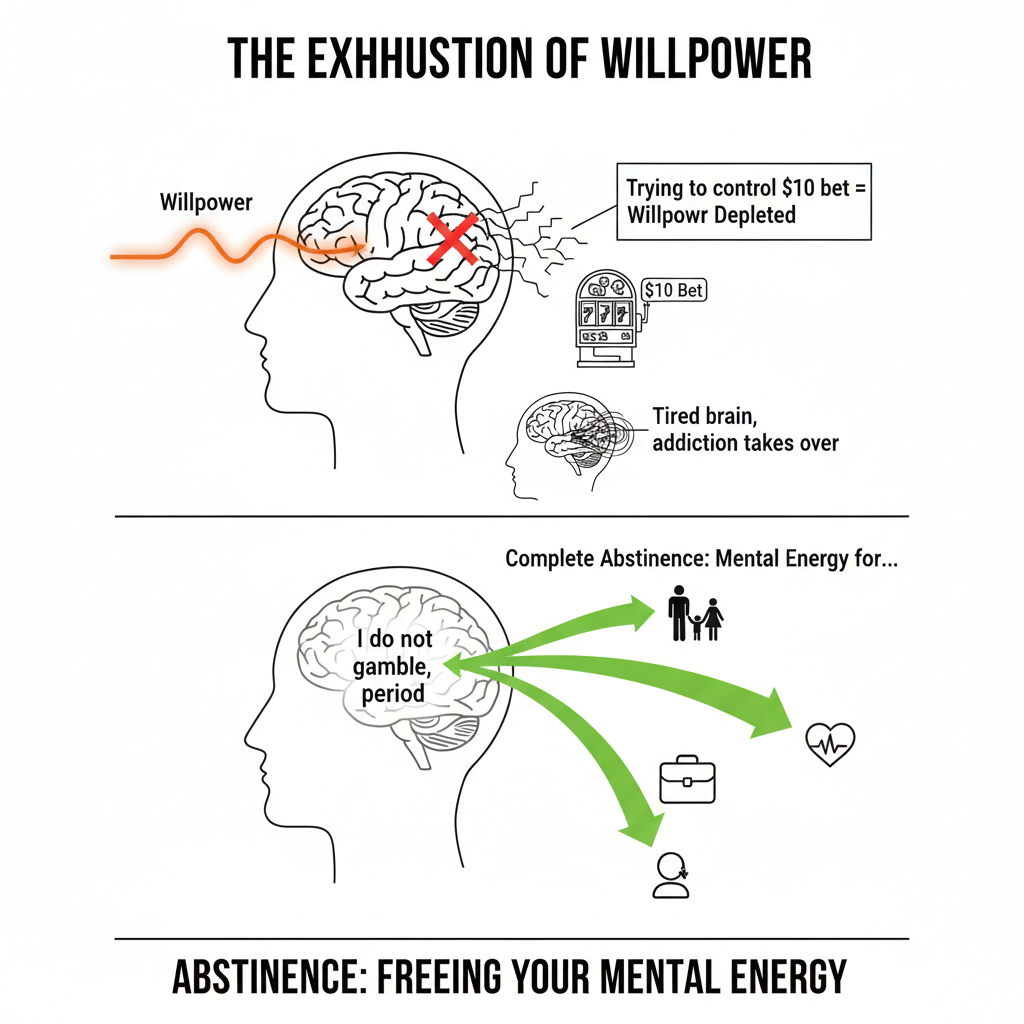
If you spend all your energy trying to control a $10 bet, you will eventually get tired. And when you get tired, the addiction will take over.
Complete abstinence is actually easier than moderation.
When the decision is “I do not gamble, period,” you don’t have to make a thousand small decisions during the session. You made one big decision, and that settles it.
It frees up your mental energy for things that actually matter—your family, your career, and your health.
How to Stop the Small Bet Before It Starts
To treat a $10 bet with the same severity as a $10,000 bet, you need a structured framework:
- Identify the Lie: When the thought “it’s only a small amount” appears, label it immediately as a lie.
- Play the Tape Forward: Don’t look at the start of the bet; visualize the regret and the inevitable chase that follows three hours later.
- Use External Barriers: Do not rely on your internal willpower alone, as it can fail when you hit time limits or high stress.
Instead of relying solely on your willpower, you can miter a permanent seal on your access to betting sites by trying our LucidoApp Chrome extension to create a decisive external barrier.
